Tuesday was audit day.
There comes a moment on every expedition when you must stop moving, unfold the map, and make certain that the country beneath your feet is actually the country drawn upon the paper.
So we opened the books and went through every formula, one by one, comparing our implementation with the literature and with the methods used by people who have been calculating these things for far longer than we have.
The first surprise was a matter of identity.
Our code contained a formula labelled “Spencer, 1971.”
Except Spencer was not Spencer.
It was Cooper, 1969.
A simple sine-based approximation, useful enough for a quick calculation, but nowhere near the formula we had intended to use. The real Spencer equation has seven terms and roughly ten times less error.
We separated the two gentlemen and returned their names to them.
Cooper remained in the code.
This time, with the correct label.
The second error was better concealed.
A value that was supposed to change every day of the year had been stuck on January 1st.
Which meant that whether it was March, August or December, the calculator was using the Sun’s position from the first day of the year for that calculation.
A small programming accident.
An entire year of the wrong Sun.
We had not noticed because the difference was not dramatic.
But in an astronomical calculator, “almost right” is simply another way of saying check it again.
Then we found the equation of time.
It is the small correction between solar time and the time shown by the clock on the wall. In our code, the correction began one day late.
One day.
Out of 365.
We moved it back where it belonged.
Then came the more expensive discovery.
We were counting the losses twice.
The cables lost something. Dust lost something. The inverter lost something.
And then, under another name, those same losses were being subtracted again.
The calculator had consequently become far too pessimistic, producing estimates roughly ten percent lower than they should have been.
We kept a single correction.
After that, the day was no longer about repairing things.
It was about adding them.
For the light that does not arrive directly from the Sun, but from the entire sky, we introduced the Perez model. A model that understands that the sky is not a uniform lamp, and that the light near the horizon behaves differently from the light around the zenith.
Then came panel temperature.
A hot panel produces less than a cool one, and July on the Bărăgan plain is not the same July as in Sinaia.
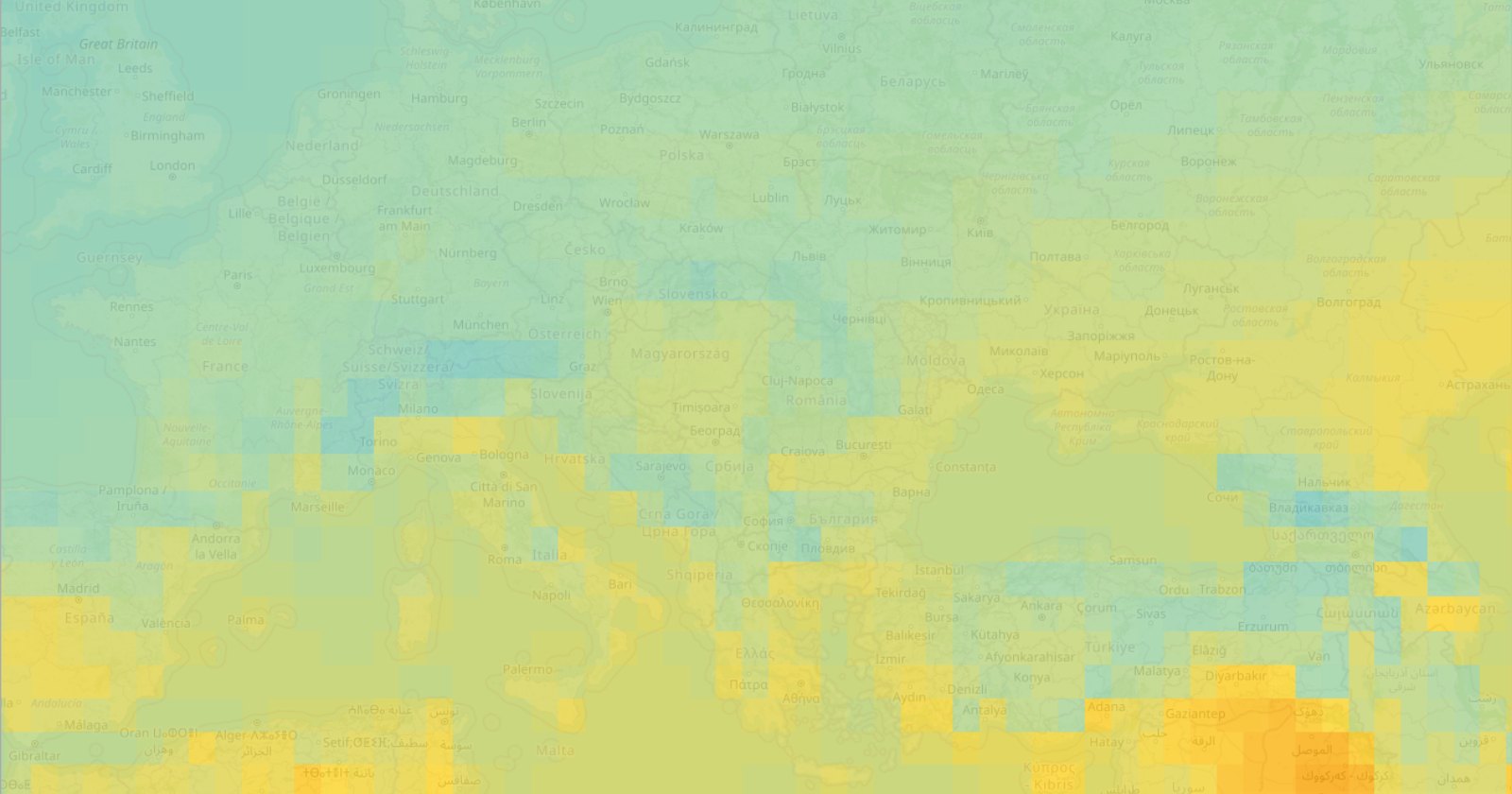
Once again, NASA provided the climate data we needed: monthly mean temperatures.
And finally, altitude.
The house was no longer merely a point on a map. It now stood at a particular height above sea level, obtained from a digital terrain model with cells roughly 90 metres across.
When the day was over, the calculator produced different numbers from those it had produced that morning.
The Sun had not changed.
The sky had not changed.
The house had not moved.
We were the ones who had been wrong.
And a calculator does not become more truthful by producing prettier numbers.
It becomes more truthful when you begin telling it the truth about the world it is trying to describe.