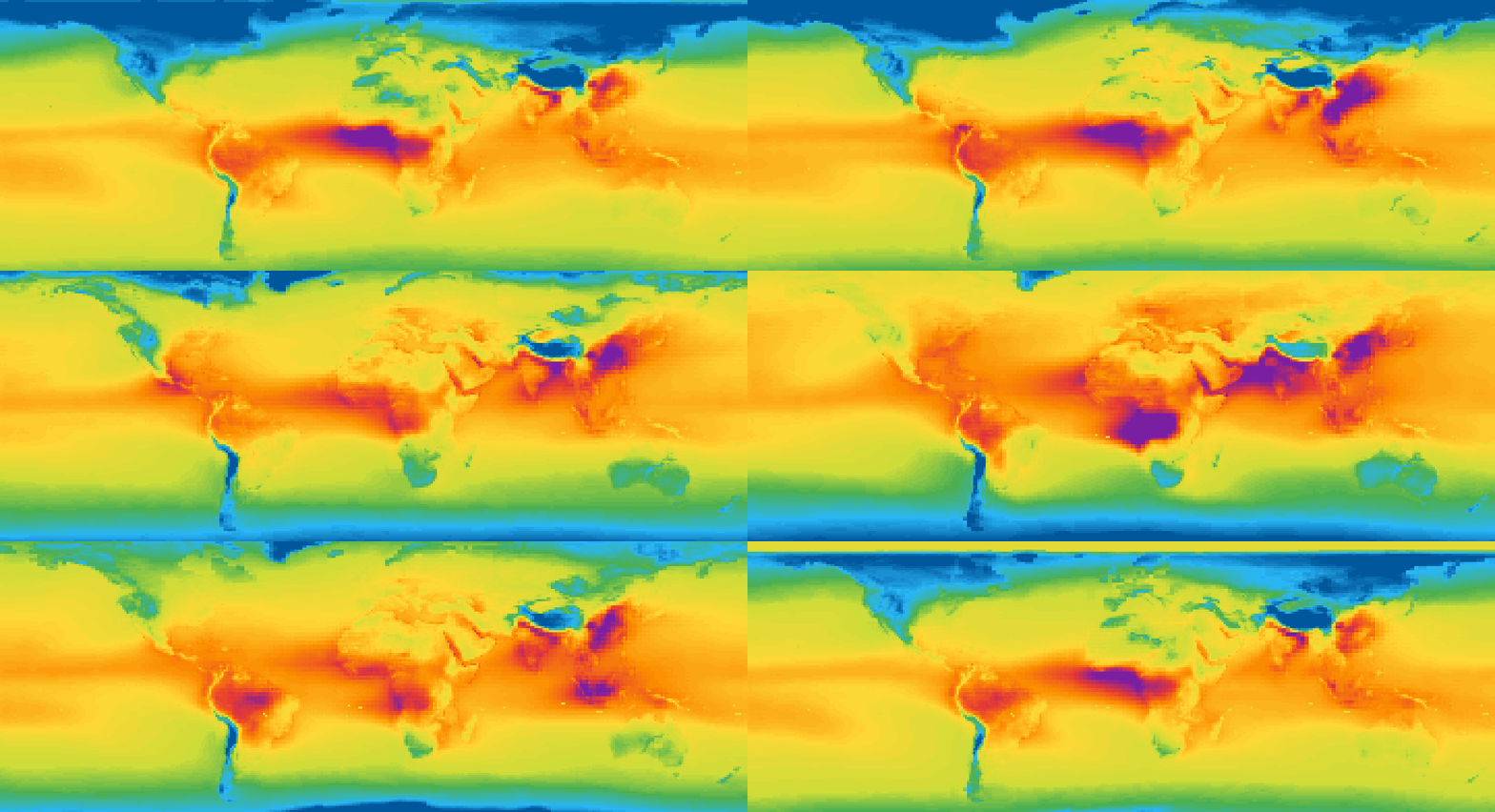
On Tuesday we asked ourselves how much dust there is in the sky.
Not figuratively. That is, quite literally, what happens to the light: it leaves the Sun, reaches the top of the atmosphere with an amount of power we can determine with reasonable precision, and then begins its journey through the air. The trouble is that air is not empty, and what looks from the ground like a perfectly clear sky is actually a mixture of gases, water vapour, dust, smoke, sea salt, pollen and various other particles which were not officially invited but participate in the journey of the light anyway. The more of them there are, the less light reaches the ground, even on a day when there is not a single cloud in sight.
Meteorologists have a number for this. It is called Linke turbidity, after Wilhelm Linke, who worked with the concept in the 1920s, and it describes, in essence, how strongly the real atmosphere attenuates sunlight compared with an idealized clean and dry atmosphere. A value around 2 can be found in very clear mountain air; a city in summer may reach 4 or 5, while heavily dust-laden regions, such as desert areas during strong wind events, can exceed 6.
We did not have this number for any part of the world.
So we did what we usually do when we do not have a value we can measure directly: we calculated it backwards.
We asked NASA how much light reaches the ground at a particular location, in a particular month, under clear-sky conditions, using the available climatological data. We then made our formula search for the Linke turbidity value that would produce the same result. Give it 2 and there is too much light; try 4 and there is too little; try 3 and you are close; try 3.1 and, if the result is close enough, you stop. It is a simple inverse problem, but it has to be solved a very large number of times, for every point on the map and for every month.
The first version, using five-degree cells, took nine minutes. That was fast enough to give us the impression that the problem was nearly solved, which is usually a fairly reliable indication that we are about to discover that it is not.
The second version, using one-degree cells, took fourteen hours. We left it running overnight and gave it a progress file, so that if the process stopped for some reason it could continue from where it had left off instead of making us calculate the entire planet again merely because a computer had decided to have a difficult night.
Meanwhile, we found two mistakes.
The first was entirely ours. The first version had forgotten diffuse light, the part of solar radiation that does not arrive directly from the Sun but reaches the ground after being scattered through the atmosphere. The result was simple and rather unpleasant: approximately seven percent of the light was missing from every location we calculated. We corrected the formula and ran the calculation again.
The second mistake was more entertaining.
Somewhere in the code there was a function expecting four values, but the code calling it was sending only three. The fourth value, the one that was supposed to describe how turbid the atmosphere was, was therefore being replaced, accidentally, by the longitude of the location. For Brașov, the longitude is approximately 25.6 degrees east. Which meant that, for several hours, our program believed that above Brașov there were the equivalent of twenty-five dusty atmospheres stacked one on top of another.
The sky over Brașov is not quite that uncooperative.
We fixed that problem as well, and then did something that seemed almost inevitable after spending so many hours staring at numbers: we turned the result into a map. You can now move the month with a slider and watch atmospheric turbidity change through the year. Desert regions turn orange, the oceans remain blue, and areas experiencing polar night are hatched, because the Sun does not rise there and therefore there is no solar radiation for the model to calculate.
Until Tuesday, our sky was essentially equally clean everywhere. Not because the Earth is like that, but because the program did not yet know the difference.
As of Tuesday, the atmosphere finally has a character of its own.